by Ron Doerfler and Miles Forster
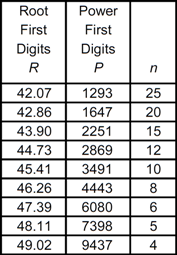 Part I of this essay provided background information that demonstrates the difficulty of the problem of mental extraction of 13th roots and the efforts of calculators to master it. But can it be possible for us to extract 13th roots of 100-digit numbers without devoting portions of our life to it? With a basic talent in mental arithmetic and some study, it can certainly be done, even if not in record time. We present a new method that involves no logarithms, no antilogarithms and no factoring, one that works with 13th powers that end in 1, 3, 7 or 9 (the cases attempted by record holders). The memorization consists of one table and a few formulas. A printer-friendly PDF version of Parts I and II is linked at the end of this essay.
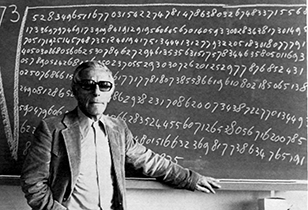 Mental calculators of note (so-called “lightning calculators”) developed areas of expertise in performing calculations that seem astonishing, even unbelievable, to the rest of us. One such specialty is calculating the 8-digit root of a 13th power of 100 digits. Achieving record times historically required massive memorization and calculating speed, racing through a procedure that remains a mystery to most people. Part I of this essay provides a historical overview of the extraction of 13th roots, including the methods used by a few mental calculators, methods that largely rely on a mix of intensive mental calculation and large-scale rote memorization. It demonstrates the creativity and drive of these marvelous people.
 I have researched and written about methods of mental calculation over the years, and I’m often surprised at the ingenuity evident in the mathematical methods developed specifically for it. Based on my Lightning Calculator series of essays
 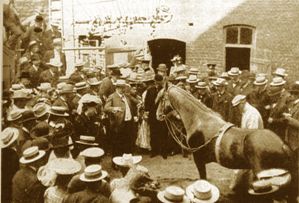 Mental calculators of yesteryear were usually described in magazines, newspapers and books in ways that can be startling in our more cynical age. But even today newspaper articles, documentaries and television features on modern lightning calculators appear almost regularly, often with a “hook” such as diminished capabilities in other areas (the “Einstein” effect). Surely there must be some reports that try to be objective, but I haven’t found them. At best they are naively written by people with little mathematical background; at worst they use considerable license (deception, really, if only by omission) to present a better story. This part of the essay is not directly related to the historical art of mental calculation itself, but I think it serves as a cautionary tale in evaluating articles on it.
 The types of calculations performed by lightning calculators were historically quite limited, notable mainly for the size of the numbers and the speed at which they were manipulated. But remember that the questioner had to verify every calculation by hand, making higher powers and roots (particularly inexact roots) much less feasible. The dawn of calculators and computers propelled some of these tasks into hitherto uncharted territories such as 13th or 23rd roots, deep roots of inexact powers, and so forth, much of it supported by more sophisticated mathematics. Here we will review the methods of calculation used in the past, many of them not commonly known, as well as other techniques that are relatively new.
 Individuals with preternatural abilities to calculate arithmetic results without pen, paper or other instruments, and to do so at astonishing speed, are the stuff of mathematical and psychological lore. These “lightning calculators” were sometimes of limited mental ability, sometimes illiterate but of average intelligence, and sometimes exceptionally bright, this despite the popular notion of the idiot savant. The techniques used by these people are not generally well known. In fact, despite claims by educators that acquiring a mental facility with arithmetic operations is essential to a student’s mathematics education, I see little in the textbooks other than simple estimations based on rounding values, surely the most basic and least interesting mental task. The field of mental calculation may not be a lost art per se, but in this digital age it most certainly is a neglected one.
 Dead Reckonings